
Thomas King
Inconvenience is not the word

I knew it was coming because I am friends with some of the people who have been doing the work for years. I, too have been doing the work for years, though I was not involved in this case. This case, like so many others, in which someone claims to be Cherokee, but is not.
In this instance it’s Thomas King, one of the most prolific “Native” authors of a generation, a man whose literary work has been transformed into screenplays and documentaries, who was given national honors in Canada, where he has lived since 1980. A man whose words on Native life, whose work about, regarding Native life, has finally been exposed as false.
And he admits it.
At least there’s that.
I don’t know what is going through his head. In an interview he claimed to still be in shock. I don’t doubt that. I don’t doubt that he believed the stories he was told.
In a follow up story, Daniel Heath Justice, one of the people who has done the most to support actual Cherokees when these pretendians are exposed, said he was surprised that people were “shocked”. Cherokees have known this for a while.
But the coverage of King belies a few telling details about how the media misunderstands, still, what it means to be Indigenous. We see terms like he “discovers” and “reveals”. He is devastated and not “part” Indigenous. What part? How did he not know? How is this a discovery rather than deception?
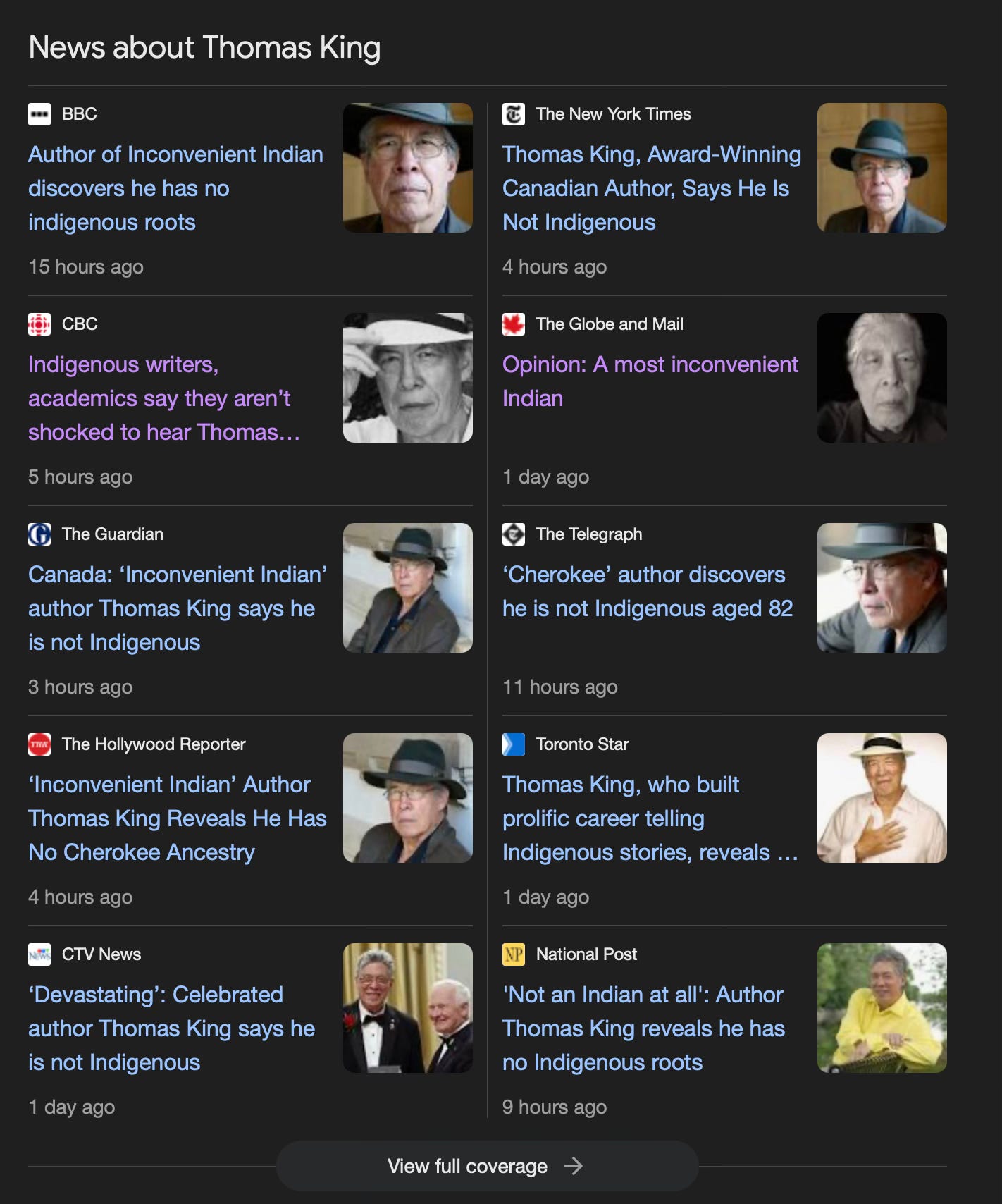
There are three points I would like to make about this case.
King has been a writer and professor for 50 years, and there have been questions about him for at least a decade, if not longer. It is not incumbent on some nebulous “other people” to determine whether he is or is not Cherokee. It’s incumbent on him because he was the one claiming it without actually being enrolled or having any verifiable connection to Cherokee people. The Cherokee tribes determine who belongs to them. Individuals cannot claim that belonging without adhering to the qualifications for citizenship in our polities.
He claims he is devastated. I believe him. And it’s not that I want this man to suffer. Plenty of people I know do. But I don’t really have the constitution for watching an elderly man’s life being ripped to shreds. Except, maybe I do, if that’s what it takes for people like him to stop. pretending. to. be. us. I want people to stop ignoring those of us who ask them how they are related to the people they claim. To stop claiming to be part of a People that has not claimed them back.
He tries to spin the devastation into the ultimate aspect of his “inconvenient” Indianness, as if his not being Indian was part of a lifelong performance behind which there is no truth, and that to fruitlessly search for that truth is somehow part of a grand scheme by which the meaning of stories is revealed to be…all just a matter of perspective. It is not inconvenient to search for truth. But it is inconvenient for us to have to deal with people like him. People who have made a living off the grift of playing Indian for profit. For laughs. For a sense of belonging to a story bigger than oneself. A story that is made up, stretched beyond all belief. And yet, people believe. Readers believe. Prize committees believe. Tenure review boards and university administrators and students and colleagues and young people just trying to get by. Yes, they believe that someone like them could make a life out of telling our stories.
But then, the inconvenient truth: he was never one of us. The stories he told are but hollow whispers of an unyielding desire to make himself special.
At the end of the day, that’s what I think it is: pretendians want to feel special. They feel alienated from whiteness because it is so violent, and yet, rather than work to diminish its violence, they take matters a different direction, inward, toward the self. Toward the ego-lust-machine that is appropriation. And appropriation is another form of theft.
At the end of the day, yet another case in which an individual claimed for himself what can only be a collective responsibility.
I love your closing points about people who claim false identities wanting to feel special AND I also appreciate you bringing complexity to this issue - it's okay to not want someone to suffer, but that doesn't make what they did right.
Thanks for this. I read _Inconvenient Indian_ years ago and thought.... Wow. I think you are spot on about white people 'wanting to be special' and stealing the work and identities of "The Other" because of the emptiness of their lives.